
Summer thunderstorms are often associated with intense rainfall over a brief time period, producing more water than the ground can absorb. This can quickly lead to ponding or standing water over flat terrain, or rapid runoff over steep slopes. The variable terrain of New Mexico can often channel water to locations that have not even received recent rainfall. In either situation, rapidly rising or fast moving water can result, often in areas that are normally dry. These events are referred to as flash floods.

Above: Thunderstorms during the 2025 Monsoon led to Flash Flooding in Farmington along U.S. Highway 64. Photo by Caitlyn Vecillio.
Flash floods also result from slow-moving thunderstorms or recurring thunderstorms that move over the same area for an extended period. Flash floods usually occur within six hours of heavy rainfall and are normally the most dangerous of floods.
Flash floods can occur quickly, often giving you just minutes to react before impacts begin. Water from flash floods can move at very fast speeds with steep and narrow drainage basins being especially prone to fast flows. These torrents of water can roll rocks, tear out trees, sweep away cars and trucks, and destroy buildings and bridges. Depending on the terrain, the spatial coverage of rainfall, and how the water is draining, water levels can quickly surge several feet in a matter of minutes. Flash flooding can also trigger catastrophic mudslides or debris flows.
Debris flows often happen in areas where excessive rain causes soil to become so saturated it turns into very runny mud. The mud then races downhill, picking up debris such as fallen branches, tree trunks, and rocks as it goes. Debris flows can bury homes under a pile of mud and debris. Know the risks of the area where you live so you can prepare your family and home before heavy rains threaten your area.
.png)
Above: Flash Flooding off of the Hermit’s Peak-Calf Canyon wildfire burn scar led to this extensive debris flow. Tons of rock and mud inundated Gallinas Creek near New Mexico State Route 65. Photo by U.S. Forest Service.
Most flooding fatalities occur in vehicles. These tragic instances usually occur when someone drives through a flooded roadway or drives around barricades meant to keep drivers out of harm’s way. Sometimes, the difference between life and death comes down to small decisions. During a flood, small decisions like turning around and not driving through a flooded roadway, or not driving around barricades, and delaying travel until conditions improve, can make a big impact on whether you keep your car...or even your life.

Above: A vehicle trying to cross a flooded arroyo is swept away in San Juan county, New Mexico. Notice the water does not appear to be all that deep, but the SUV was no match for this swift current. Photo by San Juan County Fire and Rescue.
As you approach a flooded road, you have no way of knowing exactly how deep the water is, and it is easy to underestimate the power of water, especially with fast-flowing currents. It only takes 12 inches of swift water to sweep a small car away, and 18 to 24 inches can even carry away large SUV’s, trucks, and vans. It may cost you extra time to find another route, but it could save your life. Don't become a statistic! Turn Around, Don’t Drown!
It may not seem obvious, but wildfires can lead to extreme flash flooding. If a wildfire impacts an area of steep terrain, it can drastically change the properties of the landscape, including a loss of vegetation, a hardening of the soil, and the introduction of lingering fire debris such as ash, soot, and fallen tree snags. The area impacted by a wildfire is known as a “burn scar”, and these landscape changes can often cause burn scars to be notorious areas for flash flooding and debris flows.
When vegetation is burned at high intensity, it vaporizes water repellent compounds that then condense on the ground, preventing soil from absorbing water. These high intensity burns can make the ground as water repellent as pavement. This means much less rainfall is needed to cause a flash flood. As water runs through burned areas, it causes quick erosion and picks up large amounts of ash, soil, trees, and boulders. The force of the flow can damage or destroy bridges, roads, and buildings even miles away from the burn. Most burn areas are prone to debris flows for at least 2 years, and sometimes as many as 4 or 5 years. Each burn area has a unique flood risk due to the location of population centers, burn severity, size, terrain steepness, and more.

Above: Recently burned areas known as burn scars are especially susceptible to flash floods and debris flows. Prepare now! Be aware of your surroundings and stay informed by having multiple ways to receive watches and warnings. Follow any evacuation or other instructions from local officials. If you have to shelter-in-place, get to the highest point inside your home. Go up, not out!
During the monsoon (June 15 - September 30), be sure to monitor NOAA Weather Radio, reliable local media, and weather.gov/abq. The National Weather Service issues a FLASH FLOOD WATCH to alert you to the possibility of flooding. This means that weather ingredients are starting to align for potential flooding. During a Watch you should:
Exercise caution
Listen for bulletins
Watch for signs of rising water
Be prepared to flee to higher ground on a moments notice
A FLASH FLOOD WARNING is issued by the National Weather Service when a flash flood is occurring or is imminent on certain streams or areas. A Warning is your notification to take action! When the warning is given:
Act quickly! Your margin of safety may be counted in seconds.
Get out of the danger zone and to higher ground immediately!
Avoid crossing rain-swollen streams.
If evacuating to higher ground, leave your personal belongings behind; it’s not worth risking your life!
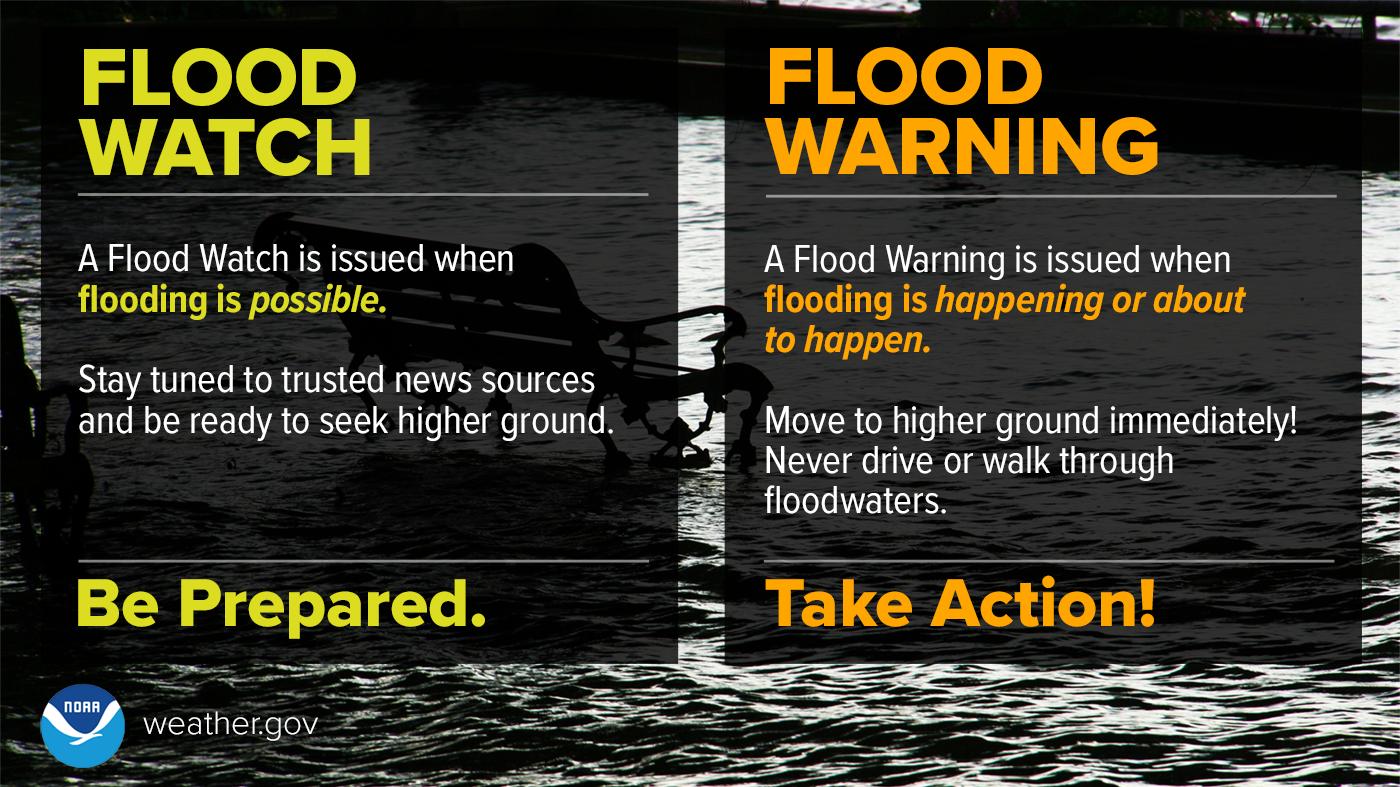
Above: A Flood Watch is your notification to be prepared. A Flood Watch is issued when flooding is possible. Stay tuned to trusted news sources and be ready to seek higher ground. A Flood Warning means take action! A Flood Warning is issued when flooding is currently happening or about to happen. A Flood Warning is your notification to take action! Move to higher ground immediately! Never drive or walk through flood waters.
Again, avoid driving over flooded roads. You often have no idea how deep the water is. The road surface may be washed out under the water, and you could be stranded or trapped.
If you live in a flood prone area, have an evacuation plan before the monsoon.
Store materials like sandbags, plywood, plastic sheeting and lumber for protection from floodwaters and to make quick repairs after a storm.
Store materials above flood levels.
Secure wanted objects to prevent them from floating away.
Learn where to find high ground which is safe from flooding. In a flash flood seek high ground quickly.
Contact an insurance agent to discuss flood insurance coverage. Flood losses are not covered under normal homeowner's insurance policies. Flood insurance is available through the National Flood Insurance Program. Get coverage early - there is a waiting period before it takes effect.


 Follow us on X
 Follow us on Facebook
 Follow us on YouTube
 ABQ RSS Feed