Please use the links below to find out more information on current flooding issues and details of any warnings that may be currently issued.
Quick Links:
Latest Information
|
||||||||
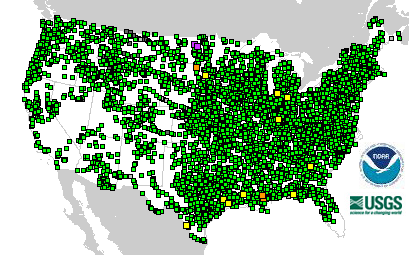
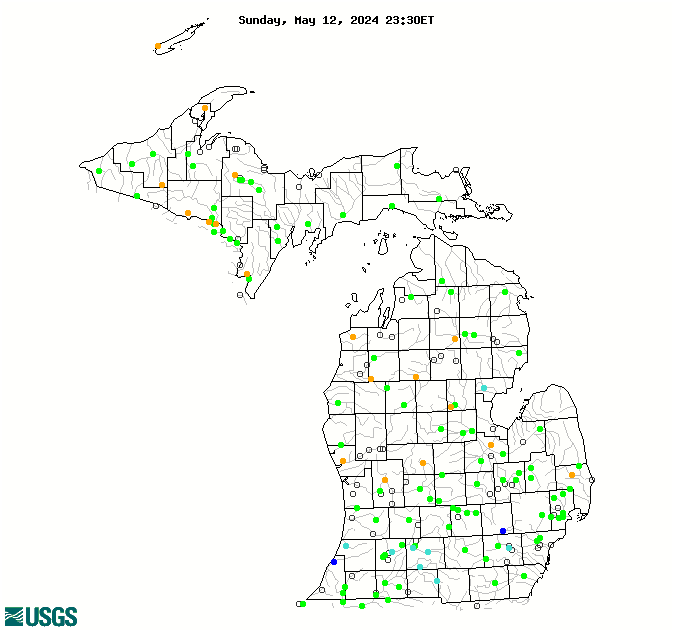
Current River/Streamflow Information
|
|||||
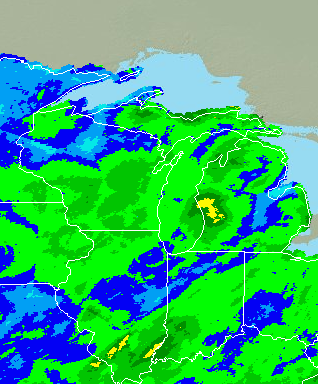
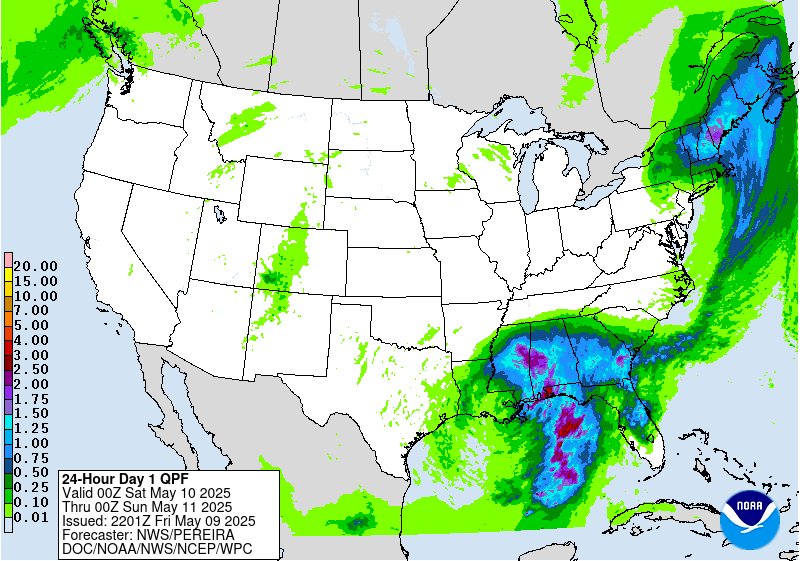
Precipitation Info/Forecasts
|
||||||||
681

ACUS01 KWNS 050600

SWODY1

SPC AC 050557


Day 1 Convective Outlook

NWS Storm Prediction Center Norman OK

1257 AM CDT Mon Oct 05 2026


Valid 051200Z - 061200Z


...NO SEVERE THUNDERSTORM AREAS FORECAST...


...SUMMARY...

Severe storms are unlikely today.


...Synopsis...

Upper ridging and accompanying mid-level northwesterly flow will

dominate most of the CONUS as a pronounced mid-level trough

overspreads New England and ejects into the Atlantic today. Surface

high pressure and large-scale subsidence will overspread much of the

U.S. east of the MS River while surface troughing becomes

established across the Great Plains, but with limited moisture. The

net result will be limited thunderstorm development over much of the

CONUS. Along the Gulf Coast into FL, a few thunderstorms may develop

ahead of a diffuse frontal boundary given the presence of seasonable

low-level moisture. A couple of lightning flashes may also accompany

a few mid-level impulses over the Great Basin, Rockies, Upper MS

Valley, and northern New England in association with localized

ascent and cooler temperatures aloft.


..Squitieri/Wendt.. 10/05/2026


$$
679

ACUS02 KWNS 050445

SWODY2

SPC AC 050443


Day 2 Convective Outlook

NWS Storm Prediction Center Norman OK

1143 PM CDT Sun Oct 04 2026


Valid 061200Z - 071200Z


...NO SEVERE THUNDERSTORM AREAS FORECAST...


...SUMMARY...

Severe storms are not expected Tuesday.


...Synopsis...

On Tuesday, a deep upper trough will eject northeastward out of the

Maritimes and New England, with a secondary low-amplitude trough

pushing across Ontario and the Upper Great Lakes through Tuesday

night. A large area of high pressure will encompass much of the

eastern states, preventing much destabilization ahead of the Great

Lakes system. Even so, weak elevated instability may support

isolated weak thunderstorms over Michigan late.


To the south, thunderstorms will again be likely over the Gulf of

America into central and southern Florida as northeast surface winds

push a cold front farther south. Weak shear and lapse rates will

preclude severe weather chances over Florida.


Elsewhere, scattered storms are expected over the eastern Great

Basin and into western Colorado, as a pocket of cooler midlevel

temperatures with a weak upper wave moves across the area. Severe

storms are unlikely, though locally strong gusts cannot be ruled out

during the afternoon due to the dry sub-cloud layer.


..Jewell.. 10/05/2026


$$
454

NWUS53 KAPX 042016

LSRAPX


Preliminary Local Storm Report

National Weather Service Gaylord MI

416 PM EDT Sun Oct 4 2026


..TIME...   ...EVENT...      ...CITY LOCATION...     ...LAT.LON...

..DATE...   ....MAG....      ..COUNTY LOCATION..ST.. ...SOURCE....

            ..REMARKS..


0250 PM     Non-Tstm Wnd Gst 1 S Sault Ste. Marie    46.47N 84.37W

10/04/2026  M45 MPH          Chippewa           MI   AWOS


            AWOS station KANJ Sault Ste Marie -

            Municipal Airport.


&&


$$
424

FXUS63 KAPX 051032

AFDAPX


Area Forecast Discussion

National Weather Service Gaylord MI

632 AM EDT Mon Oct 5 2026


.KEY MESSAGES...


- Frost/freeze tonight across the interior.


- On/off light rain showers and breezy conditions much of this

  upcoming week.


&&


.DISCUSSION...

Issued at 221 AM EDT Mon Oct 5 2026


Large and energetic trough and upper low to the northeast will

continue to move east with time today. Heights rise some in its

wake, with cool high pressure sinking over northern Michigan,

especially later this afternoon and evening. Thus, temperatures

generally in the mid to upper 50s across much of the area with low

60s near Saginaw Bay. Northwest winds remain on the slightly breezy

side today, gusts 15 to 25 mph at times. As high pressure oozes over

northern Michigan this evening, winds will decrease and the

atmosphere will decouple, resulting in efficient radiational

cooling. Overnight low temps will drop into the 30s almost

everywhere, near or below freezing across portions of the interior.

High pressure slides to the east late during the overnight hours in

response to the next piece of energy aloft and low pressure

system in the Dakotas. This will likely introduce a little

southern flow late tonight, outside of the sheltered areas and

valleys, along with increasing cloud cover, especially across

northwest lower Michigan. That being said, current forecast does

suggest frost/freeze across a good chunk of interior northern

lower Michigan.


Warm advection begins overspreading northern MI on Tuesday as

winds shift to the south and southwest. Consequently,

temperatures will be on the increase with most locations back

into the 60s. Low pressure system across the Dakotas also

marches eastward into Ontario, with the best potential for

precipitation during the evening/early overnight hours with the

better forcing and "slightly" deeper moisture. This will be

especially true across the eastern UP & vicinity. The more

noticeable feature will be the increasing winds, especially for

northwest lower MI and out over the nearshore waters. Warm

advection and the potential for a slightly messy boundary layer

may limit some wind production, but it will be breezy to windy

day nevertheless, whether on land or across the waters of Lake

Michigan.


The rest of the work week will feature breezy conditions and on/off

shower chances as energy scrapes the northern portions of the region

and the lakes respond accordingly to the cooler temperatures aloft.

Temperatures will fluctuate from milder on Wednesday (mid 60s) to a

little cooler late week with overnight lows dipping back into the

30s for some.


Rising heights this weekend will result in increasing temperatures,

especially the second half of the weekend (70s on Sunday?).

Precipitation chances during this time appear to be low.


&&


.AVIATION /12Z TAFS THROUGH 12Z TUESDAY/...

Issued at 557 AM EDT Mon Oct 5 2026


VFR conditions expected with SCT040-050 cumulus clouds today.

Expect dry conditions with breezy northwest winds, 10-15G20KTs

on average. Winds diminish late afternoon and into the

overnight, becoming more southerly on Tuesday. Mid and high

clouds push in late tonight as well.


&&


.APX WATCHES/WARNINGS/ADVISORIES...

MI...None.

MARINE...Small Craft Advisory until 7 PM EDT this evening for

     LHZ345>348.

     Small Craft Advisory until 11 AM EDT this morning for LMZ323-

     341-342-344-345.

     Gale Watch from Tuesday afternoon through Tuesday evening for

     LMZ323-341-342-344>346.

     Small Craft Advisory until 8 AM EDT this morning for LMZ346.

     Small Craft Advisory until 11 AM EDT this morning for LSZ322.

     Small Craft Advisory until 5 PM EDT this afternoon for LSZ321.


&&


$$


DISCUSSION...JLD

AVIATION...JLD
052

ACUS11 KWNS 011833

SWOMCD

SPC MCD 011832

OKZ000-KSZ000-TXZ000-012100-


Mesoscale Discussion 2345

NWS Storm Prediction Center Norman OK

0132 PM CDT Thu Oct 01 2026


Areas affected...portions of southwestern Kansas into far

northwestern Oklahoma


Concerning...Severe potential...Watch unlikely


Valid 011832Z - 012100Z


Probability of Watch Issuance...5 percent


SUMMARY...A couple of severe gusts and perhaps a brief tornado are

possible this afternoon. Given the sparse nature of the severe

threat, a WW issuance is not expected.


DISCUSSION...A 500 mb cyclone continues to slowly drift eastward

across the southern High Plains, accompanied by gradual

destabilization (given widespread cloud cover). A cold front extends

northeast from central KS to the TX Panhandle and is sagging

southward from beneath the 500 mb cyclone. To the south and east of

this front resides a marginally unstable airmass, characterized by

mid 60s F surface dewpoints beneath 6.5 C/km mid-level lapse rates,

as sampled by the 18Z DDC observed sounding.


Given ongoing widespread clouds and precipitation, it is unclear how

much additional destabilization will occur. Several storms undercut

by the front have managed to produce multiple 40-50 kt gusts per

regional ASOS/AWOS, roughly from Hamilton to Finney Counties in

southwest KS. Assuming some surface gradient flow enhancement is

underway, similar gusts may continue this afternoon. The best chance

for a brief tornado will be with storms interacting with locally

stronger ambient vertical vorticity not undercut by the front. At

the moment, the best area would be in the warm sector along the

KS/OK border. Nonetheless, the severe threat should remain too

localized and brief to warrant a WW issuance.


..Squitieri/Gleason.. 10/01/2026


...Please see www.spc.noaa.gov for graphic product...


ATTN...WFO...ICT...OUN...DDC...AMA...


LAT...LON   37280194 37750101 37860010 37899898 37729842 37419805

            37219792 36729788 36349817 36149863 36149921 36229986

            36410038 36710124 36960184 37280194


MOST PROBABLE PEAK TORNADO INTENSITY...UP TO 90 MPH

MOST PROBABLE PEAK WIND GUST...UP TO 60 MPH






 Follow us on X
 Follow us on Facebook
 Follow us on YouTube
 APX RSS Feed