| Hot Weather Decision Support | |
The NWS has three different forecast heat stress tools. Each of these tools (Heat Index, the experimental HeatRisk, and Wet Bulb Globe Temperature) have strengths and limitations and are designed for different audiences. The application of each tool must be for the appropriate audience to ensure effective utilization and heat stress awareness. |
|
Instructions: Select desired Time and Region, then choose a Forecast or Decision Tool button to view image |
|
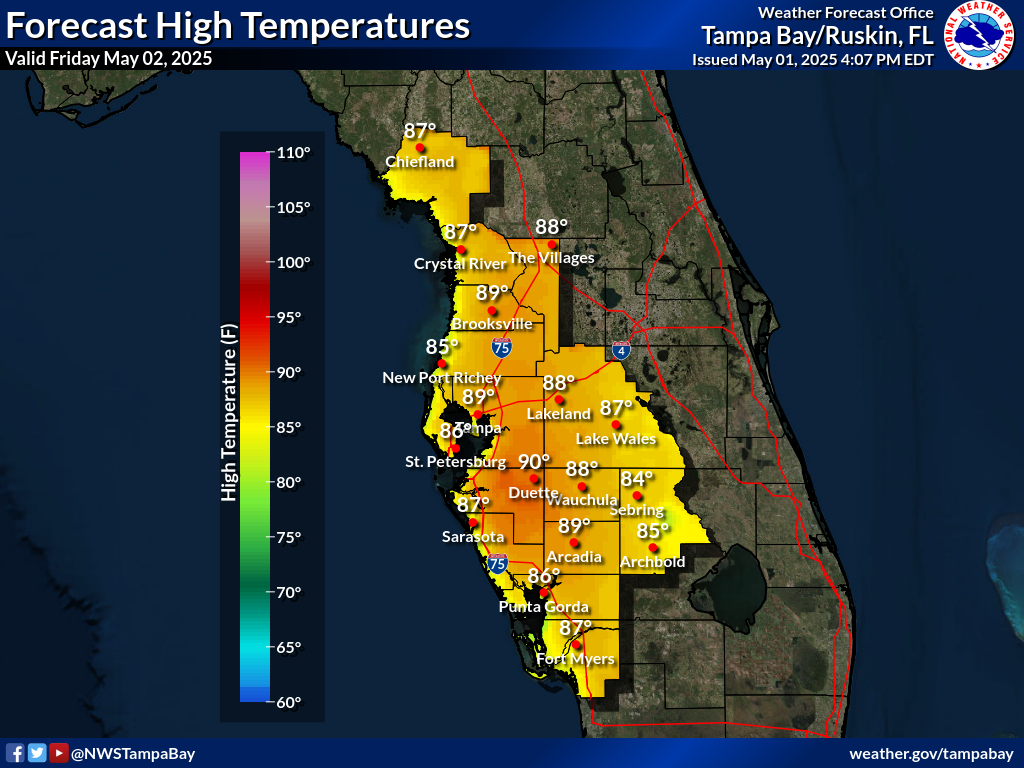
| The images below are the official NWS forecast temperatures, maximum heat index, HeatRisk, and Wet Bulb Globe Temperature Risk for the next 7 days. This data is determined by NWS forecasters to be the most likely outcome based on evaluation of data from computer models, satellite, radar, and other observations. | |
| Detailed Heat Forecast |
| Temperature Probabilities & Trends |
| NWS Heat Related Warning/Watch/Advisory Criteria |
The NWS Hazard Simplification (Haz Simp) project has led to changes to our hot weather related product suite beginning this season. These changes are designed to simplify the communication of information, improve understanding, and enhance the utility of forecasts and warnings. Detailed information about these changes can be found in the Service Change Notice and the Haz Simp Hot One-Pager. Hot Weather related Warning, Watch, and Advisory statements will be issued by the National Weather Service in Tampa Bay when the following criteria is forecast:
|
| What is the Heat Index? |
The heat index, also known as the apparent temperature, is what the temperature feels like to the human body when relative humidity is combined with the air temperature. In other words, the “feels-like” temperature. This has important considerations for the human body's comfort. |
 |
It surprises many people to learn that the heat index values forecasted and measured are for shady locations. If you are exposed to direct sunlight, the heat index value can be increased by up to 15°F. |
More detailed information, as well as records and average heat index values, can be found within our local Heat Index Statistics web page. |
| What is the NWS HeatRisk? | ||||
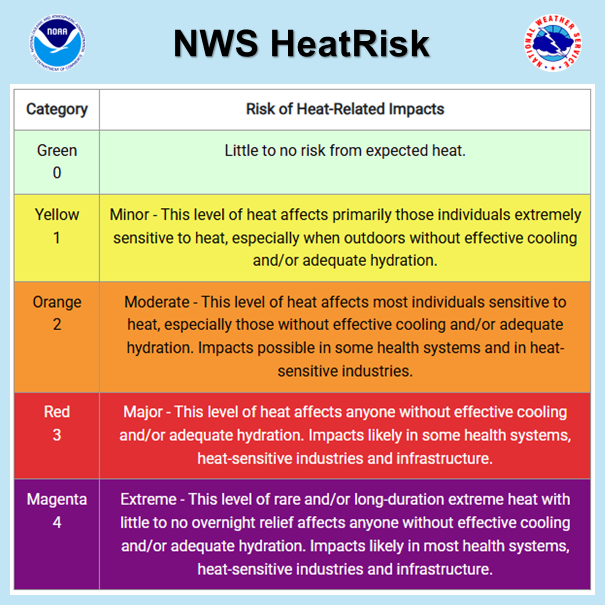
The NWS HeatRisk is an experimental color-numeric-based index that provides a forecast risk of heat-related impacts to occur over a 24-hour period. HeatRisk takes into consideration:
heat-sensitive populations
who need to take actions at levels that may be below current NWS heat product levels. A detailed breakdown of each of the categories listed below can be found here.
|
||||
 |
||||
More details and graphics about the HeatRisk can be found on the NWS HeatRisk web site, a 1-Pager is available here, and a detailed breakdown of each of the categories listed above can be found here. |
||||
| What is the Wet Bulb Globe Temperature (WBGT) |
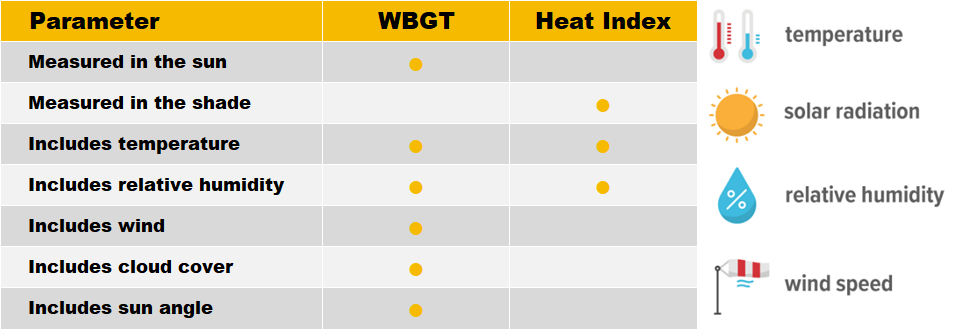
Heat stress is commonly measured by the heat index or the “feels like temperature” which is representative of the temperature and moisture in the atmosphere. An alternative method is the Wet Bulb Globe Temperature (WBGT), which uses temperature, humidity, and other weather parameters. WBGT has been shown to be an effective indicator of heat stress for active populations. The WBGT has been used for decades in many military agencies, by the Occupational Safety and Health Administration (OSHA), and organizations that facilitate marathons. The American College of Sports Medicine bases its guidelines for the intensity of sport practices on WBGT as well, and it is therefore utilized by athletic programs in many school districts. |
Comparison of WBGT and Heat Index: |
 |
Who is WBGT Most Helpful for? |
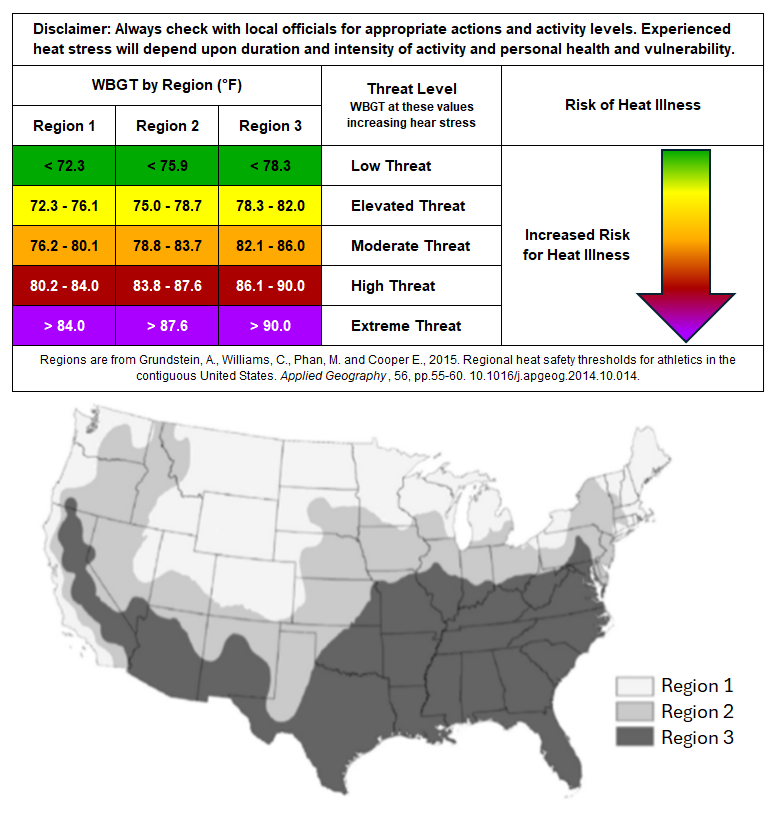
This parameter is best suited for active people such as outdoor workers, athletes, marching band, and others performing strenuous outdoor activities. WBGT can be used to establish guidelines for activity modifications during exercise or outdoor work (see WBGT Threat Level chart below). |
The Occupational Safety and Health Administration (OSHA) recommends protective measures for outdoor work:
|
WBGT Threat Level Chart |
Guidelines vary geographically since temperatures fluctuate by region, and people’s response to exercising or working in heat may also vary by the geographic region. As can be seen in the map below, Florida is in Region 3. |
 |
A good information reference on the WBGT can be found here. |


 Follow us on X
 Follow us on Facebook
 Follow us on YouTube
 TBW RSS Feed