
The nor’easter will weaken tonight, easing beach conditions and coastal flooding, though locally heavy rain will continue in parts of the Mid-Atlantic and New England into Monday. Hurricane Nolo continues to bring strong winds and large waves to Hawaii. A multi-day rain event will return to the Four Corners region Monday and expand to the south-central U.S. by midweek. Read More >
El Paso, TX
Weather Forecast Office
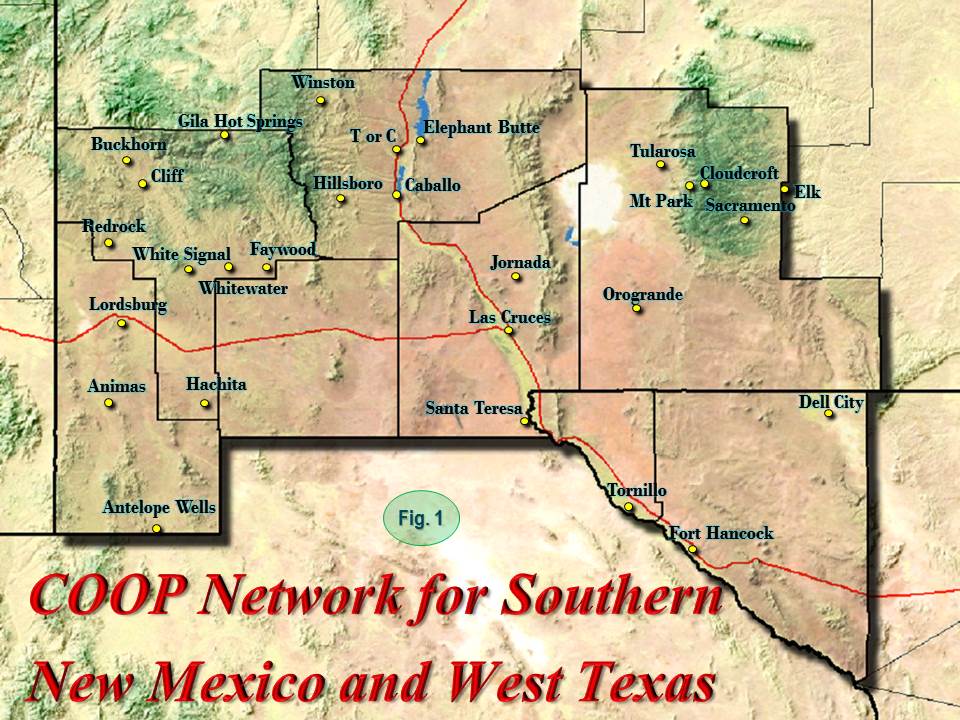
The National Weather Service Cooperative Observer Program (COOP) is a network of over 11,000 volunteer observers across the nation. The NWS in Santa Teresa currently maintains around 30 COOP sites (see fig. 1). The National Weather Service (NWS) will design and set up the site and install the equipment. The NWS also trains the observer to utilize the equipment in taking the observations and to do simple maintenance; otherwise the NWS provides the significant repair and maintenance. These observations are helpful, both for short term forecasts and maintaining a climate base to help track long term trends in the climate.
The great majority of observers take their observations at or near their residence, although a few businesses or government agencies also take observations. These observers take one observation each day of the year, usually either at 0800 or 1800 local time. The observation can be as simple as recorded rainfall, or more often reported, max/min temperatures, rainfall, snowfall and snow depth. A few sites with agricultural interests even report evaporation and soil temperature. In the past, observers filled out a paper form and sent the form end at the end of each month. Today, many observers transmit their observations electronically via telephone or computer.
For more information on the NWS COOP program, visit the NWS COOP page.
Current Hazards
Outlooks
Hazardous Weather Outlook
Local Storm Reports
Public Information Statement
National
Heat Risk
Current Conditions
Holloman AFB Radar
Regional highs/lows/precip
El Paso Radar
Rivers and Lakes
Local Observations
Satellite
Drought Monitor
Forecasts
Forecast Discussion
Graphical Forecast
Hourly Forecast
Activity Planner
Fire Weather
Aviation Weather
Climate
El Paso Climate Data
Monthly Weather Digest
Climate Graphs
Monthly Climate Data
Climate Prediction
Storm Events Database
Santa Teresa Climate Data

US Dept of Commerce
National Oceanic and Atmospheric Administration
National Weather Service
El Paso, TX
7955 Airport Rd
Santa Teresa, NM 88008
(575) 589-4088
Comments? Questions? Please Contact Us.


 Follow us on X
 Follow us on Facebook
 Follow us on YouTube
 EPZ RSS Feed