
Areas of rain and thunderstorms are forecast Monday across the central and eastern states. Some mixed rain and snow is possible in the high Sierra Mountains. Heavy to excessive rain may bring flooding in the central Appalachians. Read More >
Western and Central Wyoming
Weather Forecast Office
...Current water year precipitation is averaging 90 to 100 percent of normal across Wyoming……Mountain snowpack across Wyoming is 105 to 115 percent of median...
…Near normal (95 to 105 percent) snowmelt streamflow volumes are expected across Wyoming during the upcoming snowmelt runoff season…
…Wyoming reservoir storages remain at 115 to 125 percent of average for February…
January 2018 precipitation totals across Wyoming were 90 to 100 percent of average. Precipitation numbers varied between 140 percent of normal over the Crow/Lodgepole Creek Drainage (extreme southeast Wyoming) to near 81 percent of average over the Wind River Watershed (west central Wyoming). Current water year (October 2017 - January 2018) precipitation across Wyoming is 90 to 100 percent of average.
Mountain snowpack across Wyoming remained at 105 to 115 percent of median by early February. Snowpack "water" numbers and/or SWEs were the highest across basins in northwest to north central Wyoming—varying between 120 to 150 percent of median. SWEs across basins in south central to southeastern Wyoming were 70 to 100 percent of median.
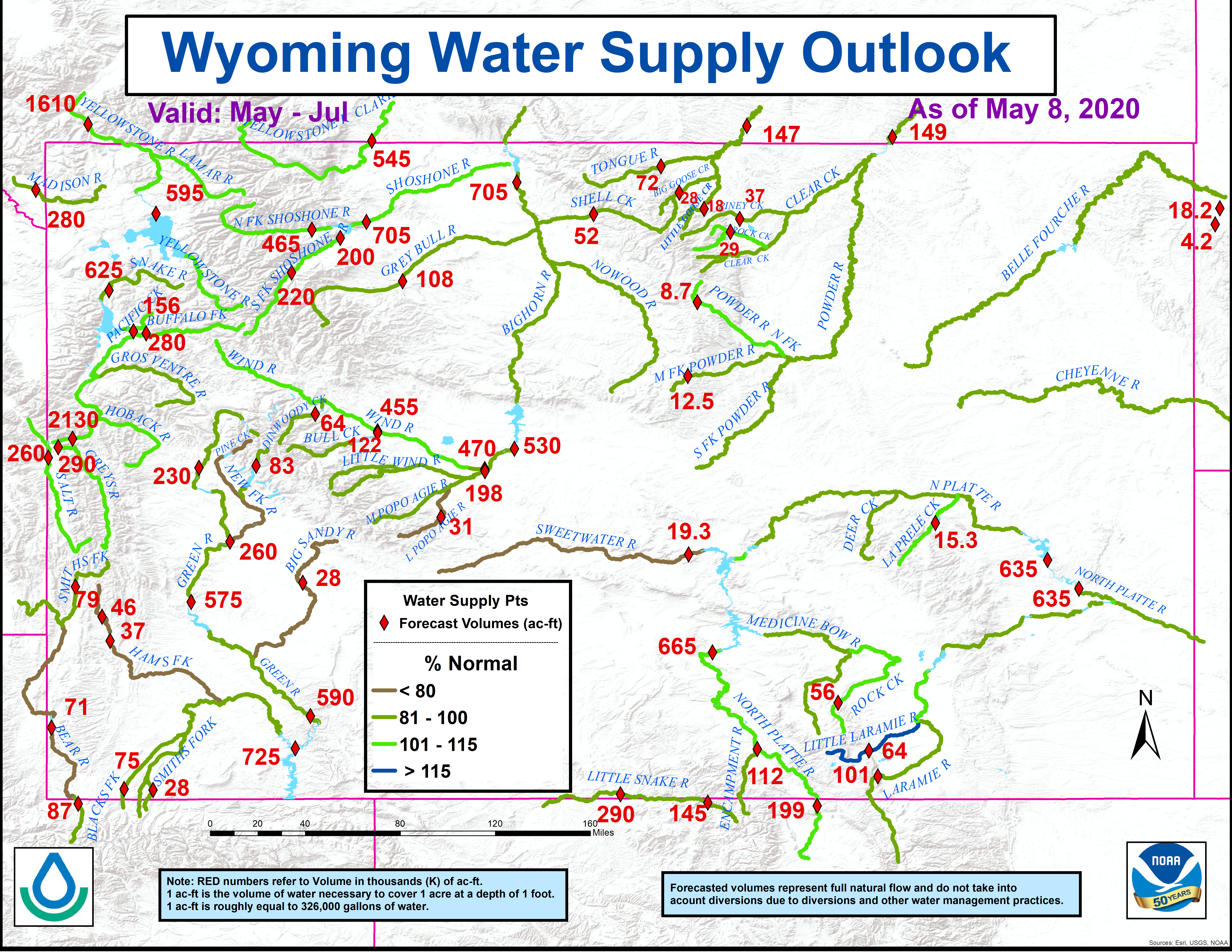
Near normal (95 to 105 percent) snowmelt streamflow volumes are expected across Wyoming during the upcoming snowmelt runoff season. Above average (>120 percent) streamflow volumes are still forecasted across portions of the Wind, Bighorn, Shoshone, and Upper Yellowstone Watersheds. The Tongue, Lower Green, Upper North Platte, and Little Snake Basins are still expected to have below to near normal streamflow volumes during the upcoming snowmelt runoff season.
Reservoirs storages across Wyoming remained above average at 115 to 125 percent for February.
The latest Wyoming water supply outlook graphic:
Forecasts
Severe Weather
Forecast Discussion
User Defined Forecast
Fire Weather
Activity Planner
Hourly Forecasts
Snow and Avalanche
Aviation Weather Decision Support
Hydrology
SnoTel Page
Rivers and Lakes
Weather Safety
Preparedness
SkyWarn
StormReady
NOAA Weather Radio

US Dept of Commerce
National Oceanic and Atmospheric Administration
National Weather Service
Western and Central Wyoming
12744 West U.S. Hwy 26
Riverton, WY 82501
307-857-3898
Comments? Questions? Please Contact Us.


 Follow us on X
 Follow us on Facebook
 Follow us on YouTube
 RIW RSS Feed